QEMU PR Validation
Pull requests to the patina repository are automatically validated against QEMU-based virtual machine platforms to
ensure that incoming Rust changes compile and boot correctly on supported targets. This workflow runs after CI completes
and posts the results directly to the pull request as a comment.
This documentation is intended for those more interested in the details behind this process. Otherwise, you do not need to understand the inner workings of the workflow, it simply runs automatically on every PR and provides feedback in a PR comment.
Overview
Patina repositories are designed to optimize the developer experience. While the QEMU PR validation workflow directly supports this goal by providing boot results on every push to a Patina pull request, this capability is enabled by leveraging the existing developer facilities available across Patina repositories.
Dependencies
The workflow relies on several repositories and components:
- patina — The main Patina development repository.
- Contains the lightweight caller workflow files that trigger QEMU validation on pull requests.
- Depends on: GitHub workflow files (callers), patina source code, and incoming PR changes
- patina-devops — Reusable workflows and composite actions
that implement the overall workflow and validation logic.
- Depends on: GitHub workflow files (callees) and GitHub actions
- patina-fw-patcher — Tools used to patch the Patina DXE
Core binary into the pre-compiled firmware ROM.
- Depends on: The Patina patching script (
patch.py)- Note: This script can patch a Patina binary into a firmware ROM on physical and virtual platforms to prevent rebuilding the rest of the ROM image.
- Depends on: The Patina patching script (
- patina-dxe-core-qemu — An integration repository for
building the Patina DXE Core for QEMU platforms, combining Patina code with platform customizations.
- Relevant Inputs: Rust library crates (such as the
patinacrate), platform customizations, and build configuration. - Relevant Output: Patina DXE Core EFI binaries built for QEMU platforms.
- Depends on: The
patina-dxe-core-qemusource code
- Relevant Inputs: Rust library crates (such as the
- patina-qemu — Hosts the actual UEFI firmware code that is
built into a ROM image and run as the firmware on QEMU virtual machines.
- Relevant Inputs: Patina DXE Core EFI binary and QEMU platform UEFI code.
- Relevant Output: Firmware ROM binaries built with the Patina DXE Core that can be booted on QEMU.
- Depends on: The latest ROM image made available as release asset in
patina-qemuGitHub releases
Supported Platforms
| Platform | Host Operating System | Architecture |
|---|---|---|
| Q35 | Linux | x86_64 |
| ArmVirt | Linux | aarch64 |
| Q35 | Windows | x86_64 |
At any given time, a subset of these platforms may be disabled due to known issues or maintenance work. The PR comment will indicate which platforms were actually validated on each run.
Workflow Lifecycle
The QEMU PR validation workflow builds the patina-dxe-core-qemu integration repository with the PR's changes patched in, then boots the resulting firmware on QEMU for each supported platform and operating system combination. Results are posted back to the PR as a single comment that is updated on each subsequent push.
The workflow maintains a state machine to track the progress and outcome of each run. Those states are reflected in the comments posted in the pull request. The main states include:
-
Transient states:
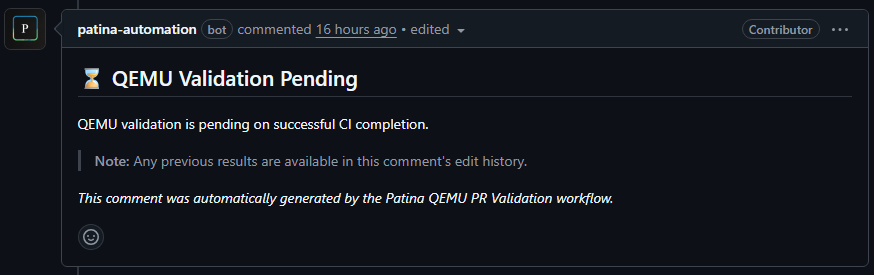
- Pending — The workflow is waiting for CI to complete. This state is set immediately when a PR is opened or updated. If CI fails, the workflow will not leave this state as no further validation will be attempted.
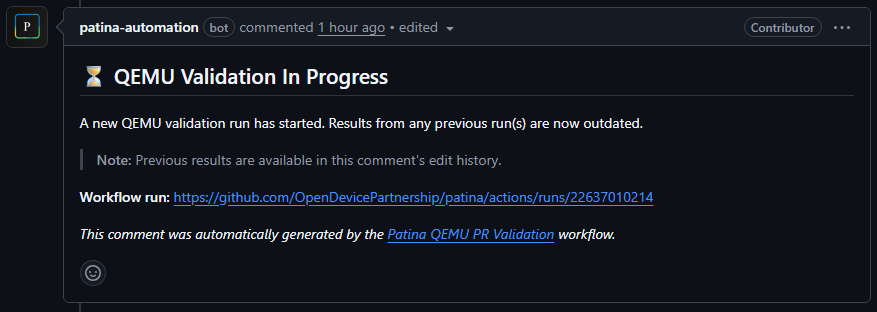
- In Progress — The workflow has started running on the latest commit.
-
Terminal states:
- Preflight results:
- Version Mismatch — The major version of
patinain the PR does not match the major version currently used inpatina-dxe-core-qemu. The integration repository must be updated before validation can run. Any patina member that sees this state, should update thepatina-dxe-core-qemurepository to depend on the new major version. - Assets Not Ready — The latest
patina-qemurelease does not yet have the firmware ROM assets available. This can occur immediately after a newpatina-qemurelease is created and assets are still being uploaded. Any patina member that sees this state, should verify that the latestpatina-qemurelease is in progress and wait for it to complete before rerunning the workflow.
- Version Mismatch — The major version of
- Build and runtime results:
- Success — The firmware built and booted successfully on all validated platforms.
- Build Failure — The firmware failed to build for at least one platform. The comment includes details about
which platforms failed and links to the build logs.
- It is possible that a
patinaPR has changes that will break thepatina-dxe-core-qemubuild. In this case, a repository admin or PR reviewer can override the status check to allow the PR to merge. A note in the comment posted also provides this guidance. The integration repository should be updated as soon as possible to restore validation for future PRs.
- It is possible that a
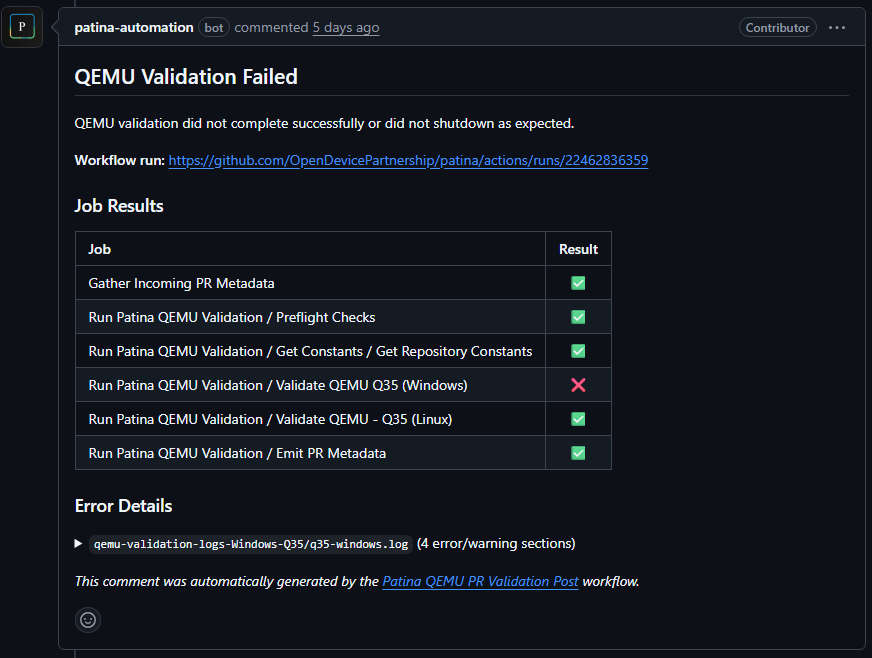
- Runtime Failure — The firmware built successfully but failed to boot on at least one platform. The comment includes details about which platforms failed and links to the execution logs.
- Preflight results:
flowchart TD
    A["PR opened / updated"] --> B["Pending Notification"]
    B --> C["CI Workflow"]
    C -->|CI fails| Z["No QEMU validation"]
    C -->|CI succeeds| D["QEMU PR Validation"]
    D --> E["Preflight Checks"]
    E -->|Version mismatch| F["Post mismatch comment"]
    E -->|Assets not ready| G["Post assets-not-ready comment"]
    E -->|Ready| H["Build & Run on QEMU"]
    H --> I["Emit PR Metadata (Transfer State)"]
    I --> J["Post-Processing Workflow"]
    J --> K["Post results comment on PR"]
Phase 1: Pending Notification
When a pull request is opened, synchronized, or reopened, a lightweight workflow immediately posts (or updates) a comment on the PR indicating that QEMU validation is pending. This prevents stale results from a previous push from being visible while CI is still running.
Phase 2: CI Gate
QEMU validation only runs after the CI workflow completes successfully. If CI fails, QEMU validation is skipped entirely. This avoids wasting compute resources on code that does not pass basic checks.
Phase 3: QEMU PR Validation
This is the main workflow. It is triggered after CI succeeds for a pull request. Concurrent runs for the same PR branch are automatically cancelled so only the latest push is validated.
The workflow is organized into the following jobs:
flowchart TD
    N["Post In-Progress Notification Comment"] --> P["Preflight Checks"]
    P -->|Ready| L["Validate QEMU (Linux): Q35 + ArmVirt"]
    P -->|Ready| W["Validate QEMU (Windows): Q35"]
    L --> M["Emit PR Metadata (Transfer State)"]
    W --> M
    M --> Post["Post-Processing Workflow"]
The Linux and Windows jobs run in parallel. Additionally, a matrix is used within the Linux job to further parallelize validation across the Q35 and ArmVirt platforms.
While full support is available for building and running on Linux and Windows hosts, there is not a significant advantage for doing so from a Patina firmware validation perspective. It may be decided to focus on Linux hosts in the future to reduce maintenance overhead, however, the code for both should always be kept up to date and runnable to preserve the option for Windows validation in the future if desired.
In-Progress Notification
The existing PR comment is updated to indicate that a QEMU validation run has started. It is noted in the comment that previous results are preserved in the comment's edit history.
Preflight Checks
Before building or running anything, the preflight job verifies that the environment is ready:
-
Version compatibility — The major version of the
patinacrate in the PR is compared against the major version expected bypatina-dxe-core-qemu. If there is a major version mismatch, validation cannot proceed and a comment is posted explaining the situation. -
Firmware asset availability — Pre-compiled firmware binaries are published as release assets in patina-qemu. The preflight job confirms that firmware zip files for all platforms exist in the latest release. If they are still being uploaded (e.g., immediately after a new release is created), validation is deferred. This is needed because the workflow only patches the PR's Patina DXE Core into existing patina-qemu releases, it does not rebuild the rest of the firmware image.
-
Caching — The GitHub cache is used to reduce GitHub API callouts across runs. Cache keys are derived from release tags and commit hashes so they automatically invalidate when upstream repositories change.
Platform Validation
Once preflight checks pass, parallel jobs build and run the firmware on each platform/OS combination.
Each validation job performs the following steps:
- Checkout the
patinarepository at the PR's head commit. - Clone dependencies —
patina-dxe-core-qemu,patina-fw-patcher, andpatina-qemuare cloned and set up.- Note:
patina-qemuis sparse cloned to only fetch the firmware assets and build script, skipping the full QEMU source code to save time and space.
- Note:
- Build —
patina-dxe-core-qemuis built with a crate patch pointing to the PR'spatinasource. This replaces the releasedpatinacrate with the PR's version so the build and execution include the proposed changes. - Download firmware — Pre-compiled firmware ROM files are downloaded from the latest
patina-qemurelease (cached when possible). - Run QEMU — The firmware is booted on QEMU in headless mode. QEMU is configured to shut down after the boot
completes so the job can verify that the boot succeeded.
- Currently, only boot to EFI shell is verified in this workflow.
- Upload logs — Build and execution logs are uploaded as workflow artifacts.
The build and run phases are separated so that build failures and runtime failures can be clearly distinguished in the results.
Metadata Emission
After all platform validation jobs complete (regardless of success or failure), a final job collects the outcomes from each job and writes a metadata JSON artifact. This artifact is consumed by the post-processing workflow. This step simply exists to transfer data in a clean, auditable way between workflows.
Phase 4: Post-Processing
The post-processing workflow is triggered after the QEMU PR Validation workflow completes. This workflow downloads the metadata and log artifacts from the validation run, then posts (or updates) a comment on the PR with the results.
PR Comment Behavior
All QEMU validation feedback is consolidated into a single comment on the PR. The comment is created on the first run and updated in place on subsequent pushes. The edit history of the comment preserves results from previous runs.
The comment content varies depending on the outcome:
| Outcome | Comment Content |
|---|---|
| Pending | Indicates QEMU validation is waiting for CI to complete. |
| In Progress | Indicates a validation run has started. |
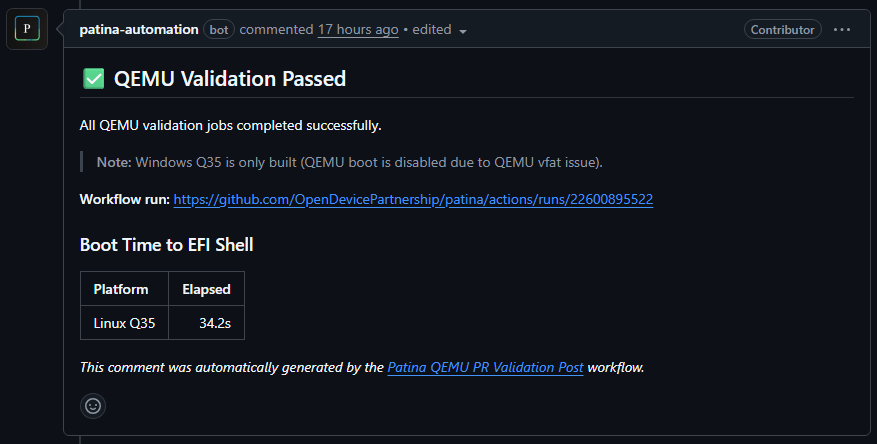
| Success | Lists all jobs as passed. Includes a boot time summary table. |
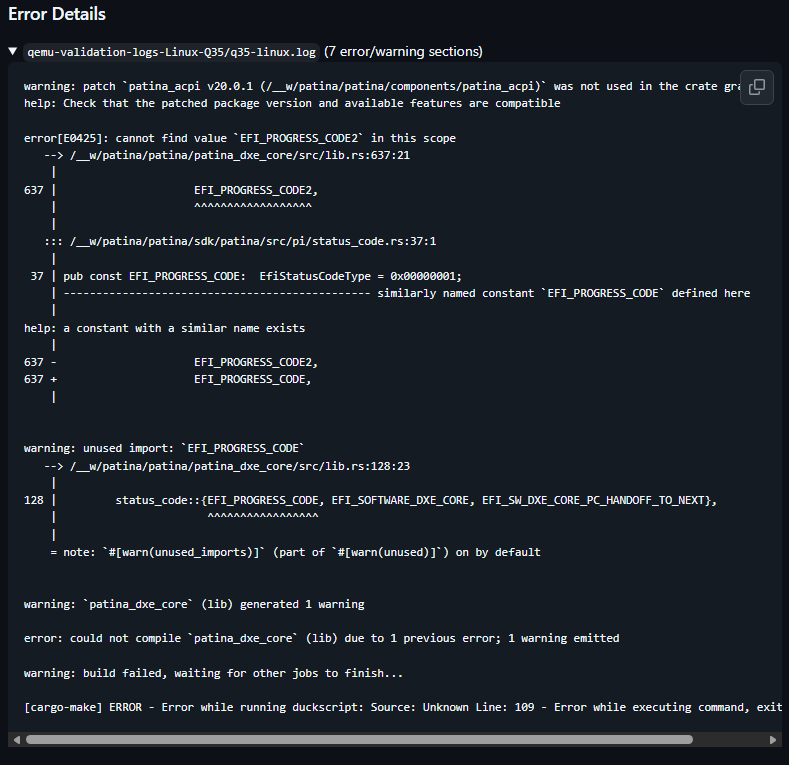
| Build Failure | Highlights which jobs had build failures. Includes extracted compiler error snippets and links to log artifacts. |
| Runtime Failure | Shows a job result table with error details extracted from execution logs. |
| Version Mismatch | Explains that patina-dxe-core-qemu needs to be updated for the new major version. |
| Assets Not Ready | Explains that firmware binaries are not yet available in the latest patina-qemu release. |
Comment Examples
Success
Pending
In Progress
Build Failure
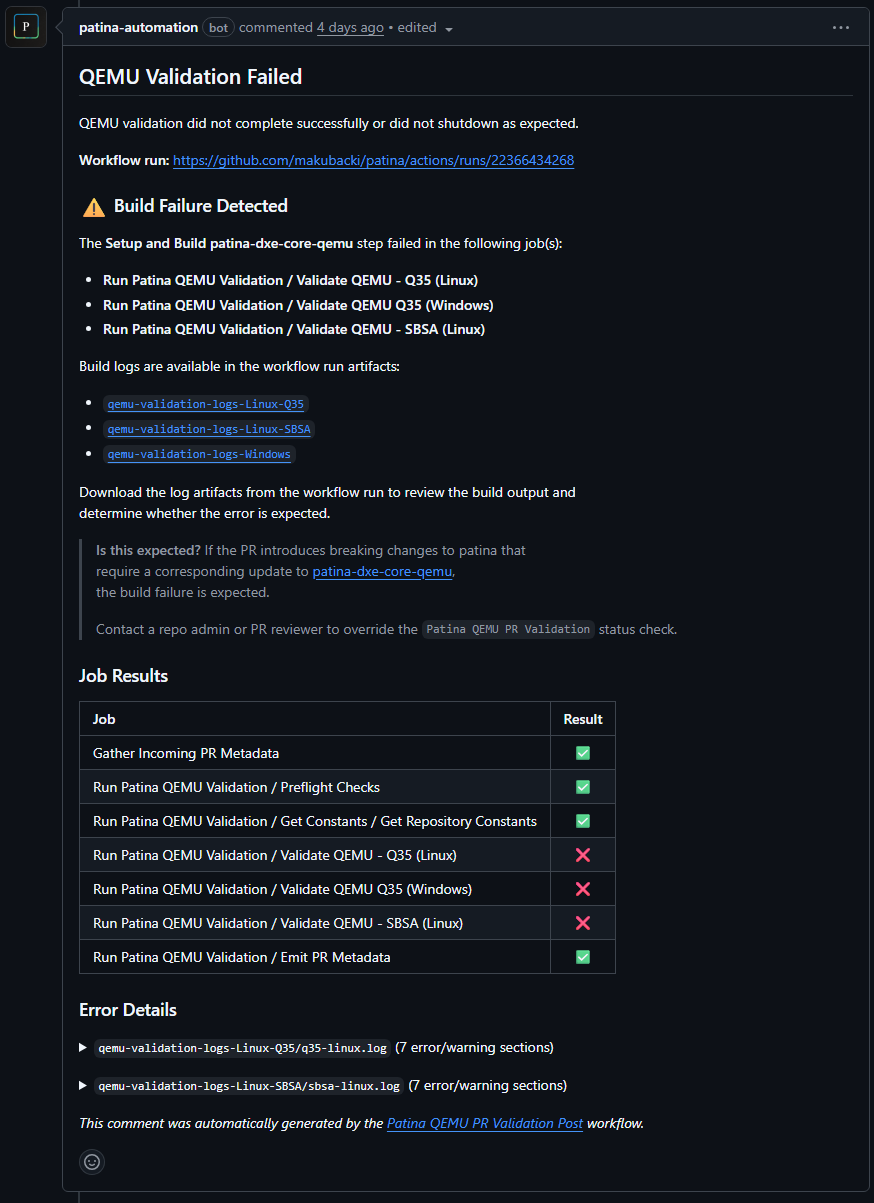
Build Failure Details
Dropping into the details of a build failure, the comment includes snippets of compiler errors extracted from the logs to help developers quickly understand the root cause without having to dig through logs. Links to the full logs are also provided for deeper investigation.
Runtime Failure
Overall Architecture
The following diagram shows the relationship between the repositories and workflows involved in the validation process.
flowchart LR
    subgraph patina ["patina repository"]
        direction TB
        W1["patina-qemu-pr-validation-pending.yml"]
        W2["patina-qemu-pr-validation.yml"]
        W3["patina-qemu-pr-validation-post.yml"]
    end

    subgraph devops ["patina-devops repository"]
        direction TB
        RW1["PatinaQemuPrValidationPending.yml"]
        RW2["PatinaQemuPrValidation.yml"]
        RW3["PatinaQemuPrValidationPost.yml"]
        A1["setup-patina-qemu-validation"]
        A2["run-patina-qemu-validation"]
        A3["extract-build-errors"]
    end

    subgraph deps ["Dependency Repositories"]
        direction TB
        DXE["patina-dxe-core-qemu"]
        QEMU["patina-qemu"]
        FW["patina-fw-patcher"]
    end

    W1 -->|"calls"| RW1
    W2 -->|"calls"| RW2
    W3 -->|"calls"| RW3

    RW2 -->|"uses"| A1
    RW2 -->|"uses"| A2
    RW3 -->|"uses"| A3

    A1 -->|"clones & builds"| DXE
    A1 -->|"clones"| FW
    A1 -->|"sparse clones"| QEMU
    A2 -->|"downloads firmware"| QEMU
There are a few reasons why the workflow is separated this way:
- Triggers - The initial workflow files in the
patinarepository are responsible for responding to GitHub events (e.g., PR opened, PR updated). These events are only available to workflows that reside in that repo. - Secrets - The CI workflow runs with a
pull_requesttrigger type. This trigger type does not have access to secrets for PRs from forks by default. However, the QEMU validation workflow needs access to secrets to make authenticated GitHub API calls and write access to post comments. The trigger for these workflows is configured to separate responsibilities from the CI workflow and allow secrets in a workflow that is independent of the initial PR event trigger. - Dependencies - Workflows depend on actions. Having workflow logic in
patina-devopsmeans those actions do not have to be duplicated across repositories that might share a workflow/action with other repositories. It also means updates to those actions are consolidated in one repo focused on devops and don't thrash the review focus and history of other repos.
Handling Expected Failures
There are cases where a QEMU validation failure is expected:
-
Breaking changes — If a PR introduces breaking API changes to
patinathat require a corresponding update topatina-dxe-core-qemu, the build step will fail because the integration repository has not yet been updated. In this case, a repository admin or PR reviewer can override the status check. -
Major version bumps — If the major version of
patinain the PR does not match whatpatina-dxe-core-qemuexpects, the preflight check will fail and report the mismatch. The integration repository must be updated before QEMU validation can run.
Troubleshooting
Viewing Full Logs
Build and execution logs are uploaded as workflow artifacts on every run. To access them:
- Navigate to the workflow run linked in the PR comment.
- Scroll to the Artifacts section at the bottom of the run summary.
- Download the
qemu-validation-logs-*artifacts for the relevant platform.